Saturday, June 13, 2026

Your Lived Experience Makes You a Better Scholar

Academic Life

Your Lived Experience Makes You a Better Scholar

What you know from your own life can become the question that shapes your strongest work.

By Tanya Golash-Boza

During my first semester of graduate school, I took a course on the sociology of education. Midway through the semester, we read John Ogbu and Signithia Fordham’s famous article on “acting White.”

The research had been conducted in Washington, D.C., where I grew up, around the same time I was in high school. As I read, I kept thinking: That is not what acting White means.

The authors argued that Black students were accused of “acting White” when they did well in school. But that did not match what I had seen at my D.C. public high school. In my experience, “acting White” was not about being smart or taking school seriously. It had more to do with how people dressed, talked, and carried themselves. It was about style, language, and social presentation. It was about wearing Doc Martens versus Timbs.

So when we discussed the article in class, I said so.

I was dismissed.

Then the woman sitting next to me said something like, “I read an article published last year on a similar topic, and those authors argued…”

The room shifted. People listened to her. The professor engaged her point. Her comment was treated as scholarship. Mine was treated as anecdote.

That moment stung. It also taught me something I needed to understand if I was going to survive graduate school with my sense of self intact.

I had gone to graduate school in part because I believed my lived experience gave me something important to say. I had grown up riding the bus from a Black neighborhood to a White neighborhood for school. That daily ride taught me what racial segregation looked like: not only where people lived, but how resources were distributed. I saw which neighborhoods had better schools, better facilities, cleaner streets, and more public investment.


By TrailVoice - originally posted to Flickr as Rock Creek Park Trail-18, CC BY-SA 2.0, https://commons.wikimedia.org/w/index.php?curid=11972653
Growing up in Washington, D.C., I learned that segregation was not abstract. Rock Creek Park marked a real divide between neighborhoods with very different levels of wealth, investment, and public resources.

But in that classroom in my first semester of graduate school, I learned that knowing something was not enough. I also had to learn how to make the academy hear me.

The lesson was not that my experience was wrong. The lesson was not that the article mattered more than what I knew. The lesson was that if I wanted to challenge the literature, I had to know the literature. I had to read the articles, understand the debates, learn the language, and figure out exactly where my argument fit.

Not so I could abandon what I knew, but so I could defend it.

This is one of the hardest lessons for many first-generation scholars, scholars of color, working-class scholars, immigrant scholars, queer scholars, and anyone whose life has brought them close to the questions they study.

You come into the academy because you know something the academy needs to know. You have seen things. You have lived through things. You have questions that did not come from a seminar room. And then, too often, the academy tells you that what you know does not count unless someone else has already published it.

That can make you doubt yourself. Don’t.

When you read an article or a book and something does not sit right with you, pay attention. You may be onto something. Take that feeling seriously enough to investigate it. That does not mean you should dismiss the scholarship. It means you should engage it.

Read more. Find out who else has asked the question. Learn what the field has already established. Figure out where the argument breaks down. Then name what is missing.

That is what scholars call a gap in the literature. But often, before it becomes a formal research question, it begins with a much simpler thought:

That’s not right.

That’s not the whole story.

They are missing what matters most.

Follow that thought.

When a theory does not explain what you have seen, that matters. When an article describes your community but gets the texture wrong, that matters. When the literature treats something as marginal and you know it is central, that matters. When scholars keep asking a question in a way that obscures the real issue, that matters.

Your lived experience is not a shortcut around scholarship. But it is also not a liability. It can help you see what others miss. It can help you ask better questions. It can tell you when an argument is elegant but false, sophisticated but incomplete, widely cited but still wrong.

The work is to bring that knowledge into conversation with evidence. Your experience gives you questions. The literature gives you context. Your research gives you evidence. Your analysis turns all of that into scholarship.

So, do not dismiss your lived experience. Do not let anyone train you to treat it as merely personal, merely anecdotal, or merely emotional. The academy has used those words for a long time to protect certain forms of knowledge and diminish others.

Everyone’s research questions are shaped by lived experience. Some scholars are trained to hide this. Others are punished for admitting it. But no one comes to their work from nowhere. We all ask the questions we ask because of what we have seen, what we have been taught to notice, what has unsettled us, and what we cannot stop trying to understand.

That is not something to run away from. It is something to embrace, especially if you are someone who comes from a background that the academy has marginalized. Your lived experience does not weaken your scholarship. It can make your scholarship stronger because it gives you a sharper sense of what matters, what is missing, and why the question is worth asking in the first place.

But also: do not stop at experience.

Read. Study. Take notes. Learn the field so well that when you speak, you can show exactly what the existing scholarship explains and exactly where it falls short.

This work can be heavy when the questions are not abstract to you. When you study violence, schools, prisons, poverty, deportation, or any other structure that has touched your own life or your community, you may carry the work differently than people who encounter it only on the page.

That does not make you less rigorous. It means you have to be honest about what you know, careful with your evidence, and protective of your own spirit. That is how you make an intervention. That is how you turn the thing you know in your bones into an argument other people have to take seriously.

Your life has given you a way of seeing. Do not let the academy take that from you. Learn the field. Sharpen your questions. Build the evidence. Then make them deal with what you know.


Preorder An Academic Life Worth Living

My forthcoming book, An Academic Life Worth Living: How to Write, Publish, and Build a Career with Joy and Meaning, is now available for preorder. If this post spoke to you, the book offers a fuller account of how to build an academic life rooted in clarity, purpose, and the questions that matter most to you.

Preorder the Book

Wednesday, July 2, 2025

Why I Still Believe in Writing Retreats (and Why You Might, Too)

More than a decade ago, I hosted my very first writing retreat in a rustic lodge inside Yosemite National Park. The accommodations were simple—bare-bones rooms with bunk beds, shared meals, and a circle of overstuffed couches where we gathered to write, vent, reflect, and dream. There were no curated meals or spa treatments. But what we had was more powerful: time, community, and a shared commitment to making space for our work. 

We were a group of academics—mothers, caregivers, first-gens, mid-career scholars, brand-new assistant professors, graduate students—figuring out not just how to write, but how to live as writers inside academia. That week wasn’t about productivity hacks or hitting word counts. It was about being part of something. We weren’t just trying to survive the academy. We were imagining new ways of belonging to it. 

Fast forward ten years, and I found myself welcoming 36 brilliant women to the Creative Connections Retreat on the island of Amorgos, Greece. The views stretched endlessly across the Aegean Sea. The beds were plush. Every meal tasted like it was prepared by someone who knew exactly what we needed. 


But even with all the beauty and luxury, the heart of it stayed the same: time, intention, community. The courage to pause and ask: What do I really want from this career? What am I ready to let go of? What am I here to build? 

These are questions I return to again and again—at writing retreats, yes, but also in hallway conversations, coffee shop catch-ups, and late-night texts with fellow scholars. They’re the questions that keep us honest when the job market feels bleak, when the teaching load is crushing, when tenure feels like golden handcuffs. 

And here’s what I tell my students, my mentees, and anyone trying to make sense of a life in academia: you don’t have to be the smartest person in the room to succeed. You just have to learn how to stay grounded, focused, consistent, and connected. 

Skills matter more than smarts. 

That’s why I lead retreats, teach graduate seminars, and write books not just about theory, but about writing habits, time management, creating space for creativity, and long-term vision. Because the work we do is real and necessary—but so is the way we do it. 

If you’ve ever found yourself wondering, How do people stay in this profession and not lose themselves?, you’re not alone. I’ve asked that same question on mountaintops in Peru, on beaches in Belize, in conference hotel lobbies, and while walking the Aegean coastline. And what I’ve found is this: we need each other. We need space to think, write, and rest. And yes, sometimes, we need a gentle nudge to remember that thriving is still possible—even in academia. 

I’m already dreaming up the 2026 Creative Connections Retreat. We will head to the breathtaking Dolomites in northern Italy—where jagged peaks, alpine meadows, and cozy mountain lodges will set the stage for deep reflection and joyful connection. Imagine writing at sunrise, hiking after lunch, and ending each day building connections over delicious Italian food. 

If this resonates with you, maybe it’s time you joined us. Sign up here to be notified when our next retreat is announced. 

In the meantime, what questions are guiding you through your current season? I’d love to hear them. Let’s keep building community together. We need it now more than ever.

Sunday, February 18, 2024

Five Tips That Will Help You Thrive as an Academic Administrator


I have been in an administrative position for just over a year now. I started in January 2023. My position is unique. I am not a Dean or Provost. I direct a Center, but the role is unusual in that I am responsible for the physical building, the budget, the staff, the faculty, and the students. We have 20 staff members, 10 adjunct or visiting faculty, and about 200 students who live in the building at any given time. Our Center is akin to a very small campus.

Because my position is unique, I have been hesitant to extrapolate from my experience and offer any general advice or reflections on being an academic administrator. 

That's me on the left - moderating a conversation with our Provost.


That said, here are five things that have helped me thrive in my first year as the Executive Director of the University of California Washington Center. 
  1. Read books on leadership and people management. There are tons of books that offer guidance and most of the advice translates to the academy. I prefer the books that are based on empirical research over the ones that are just the insights of one successful leader.
  2. Block out two hours a day for “focus time.” Use that time to do tasks that require deep thinking. For me, that is sometimes my research and sometimes strategic planning. I enjoy writing and thus make time for it but my job also requires some deep thinking so I choose which of those two kinds of tasks I will focus on each day.
  3. Be ruthless about only working eight hours a day and not working on weekends. The tasks will fit into the time you allocate them. Try it before deciding it's impossible.
  4. Be ruthless about protecting time for self-care and connection with people who care about you. For me, this involves daily meditation, yoga, daily hikes with friends, and cooking and eating home-cooked food. 
  5. Get clarity on your values and stay true to them. Only do the work if it’s meaningful to you.
What about you? Have you considered taking on an administrative position?

Friday, September 9, 2022

How Time Blocking and Time Tracking Can Keep You on Track While Working from Home

This academic year, I am back on campus and back in the office, but our adaptation to remote life means I have more work-from-home days than I did pre-COVID. The semester is just getting started, but it looks like I will have at least 3 days a week where I can work from home.

I love working from home, at least part-time. But, I also find that I can spend the entire day in front of my screen all day without feeling like I have gotten very much done. Somehow the whole day goes by, and I still haven’t gone for a walk, cleaned my kitchen, or responded to all the emails. To address this issue, I decided to pull out my toolkit and see what tools are most useful for my work-from-home days.

Drawing from the infinite wisdom of Kerry Ann Rockquemore, Raul Pacheco-Vega, and Cal Newport, I developed a system for working from home that involves a weekly template, time blocking, and time tracking.

The first step is to develop a weekly template, which I explain in more detail in this post.

This semester, I am teaching just one class, but I have a fair number of commitments and thus have a lot of meetings. Thus, my afternoons are generally blocked off for teaching and meetings. My mornings are my prime time, so that’s when I write.

Here is my weekly template for this Fall semester.

This is just a template. I can copy and paste it into a new Excel tab and adjust it according to the time I wake up and the actual meetings and tasks I have for that day. For example, on Thursday, I woke up very early (thanks to jet lag) and had two meetings planned – one at noon and one at 3pm. Before doing my meditation, I made a plan for the day based on my commitments and aspirations (which included going for a walk and doing some virtual yoga).

I pretty much never do exactly what I say I am going to do. However, I more or less stay on track by time-tracking in 30-minute increments. On Thursday, I did write for two hours as planned, but not exactly in the time slots I had planned. When it came time to do yoga, a nap seemed more appealing. Nevertheless, at the end of the day, I had written for two hours and completed a pending review. I also responded to all the emails I needed to answer and went to my meetings.

At 4:30pm, when my last meeting was over, I felt empowered to shut down my computer and go for a swim.

If I hadn’t done the time tracking and time blocking, this kind of day – which started at 4:45am and ended at 4:30pm – could feel like a 12-hour work day. But, the data make it clear that I in fact worked for 7 and a half hours, and the rest of the time was spent napping, exercising, and taking care of my basic needs. The time tracking also made it clear that I could stop working at 4:30pm as I had a very productive day.

This system may seem a little extra to some of you. But, if you find yourself floundering while working from home or not getting the self-care you hope to get, I encourage you to try a version of this system of creating a weekly template, time blocking, and time tracking.

Friday, November 12, 2021

Three Things Your Academic Book Must Have: An Argument, a Theoretical Contribution, and a Structure

I recently challenged authors on Twitter to state the core argument of their non-fiction book in a tweet. It’s harder than it sounds to state your argument clearly and succinctly. It’s also a necessary step in the manuscript development process. 

If you are writing a nonfiction book and can’t articulate the argument in a tweet, don’t worry. I have written several books, and usually have no idea what the argument is until I have drafted most of the chapters. If you aren’t there yet, keep writing and thinking. 


You need an Argument 

So, what is an argument? An argument is not a topic or a description of themes the book addresses.

Instead, as Wendy Belcher writes in her book, an argument is a statement someone can disagree with. And, as Helen Sword explains, every non-fiction book needs a question. The process of leading the reader from your question to your answer is your argument. 

Here are some examples of clear and succinct arguments from the tweet thread:


The thread inspired me to gain some clarity on my argument in the book I am currently writing. I have been writing this book since 2017, have drafted most of the chapters, and am still working on my argument. Thus, I came up with two versions. The first version describes the argument I am making in the book, using academic language. 

Disinvestment and coercive investment in Black communities in DC have displaced and dispossessed Black residents, making gentrification through racialized reinvestment possible.

I explain all those big words in the book. But, after reading through the thread, I realized I liked the arguments that use simple language better. So I tried again: 

The choice to use prisons and policing to solve the problems faced by Black communities in DC in the 20th century, instead of investing in schools, community centers, social services, health care, drug treatment, and violence prevention, is what made gentrification possible in the 21st century. 

As you can see, you can disagree with this statement. And, per Helen Sword’s guidance, my argument answers my guiding question of what factors led to gentrification. 

You need a theoretical framework 

In addition to an argument, you need a compelling theoretical framework. The theoretical framework is where you explain how your argument is novel and how it relates to what we already know about your topic. You could have a great argument like: “Mass incarceration is the New Jim Crow,” but, Michelle Alexander already made that argument so it’s unlikely anyone would want to publish that. 

An academic book does not need a literature review in the same way a dissertation does. If you don’t believe, me, pick up your favorite academic book and see how much lit review there is in the introduction. Often, it’s just a few paragraphs. It is almost never a full chapter. 

The manuscript I am working on engages with three fields: housing inequality, the War on Drugs, and gentrification. Thus, I explain in the Introduction what we already know about these three areas and how my intervention is new. 

The Introduction explains how Black communities, even those dominated by Black homeowners have been dispossessed; how poor, working, and middle-class Black communities across the city experienced disinvestment and then coercive investment, and how reinvestment is racialized today. As you can see, it all has to stay on the same theme – with a tight focus on the core argument. 

You need a structure 

Once you know what your core argument and interventions are, you need to figure out how you are building your argument throughout the book. Each chapter should contribute to your core argument.  

I am doing this in my book manuscript by focusing first on disinvestment, then on coercive investment, and then on reinvestment. This is in line with my argument that disinvestment and coercive investment in Black communities in DC have displaced and dispossessed Black residents, making gentrification through racialized reinvestment possible. 

I am not making the whole argument in each chapter, but instead focusing on one piece of the argument in each section, which includes two chapters. 

Part I: Disinvestment 
Ch 1: Disinvestment in Black DC 
Ch 2: The Violence of Disinvestment 
Part II: Coercive Investment 
Ch 3: Crack in the Neighborhood 
Ch 4: Bringing in the Feds 
Part III: Reinvestment 
Ch 5: Chocolate City No More 
Ch 6: Racialized Reinvestment 

There are other ways to build an argument. In my book Deported, I set the book up to follow a deportee’s journey, from growing up in the country of origin, to crossing the border, to growing up in the US, to getting into trouble in the US, to getting caught, to detention, and then to life after deportation. This structure allowed me to explain how global capitalism shaped each aspect of their migrant journey. 

If you are having trouble envisioning how to build your argument, try using a mind map. This is where you pull out a pen and paper, write down your argument, draw a circle around it, and start drawing more lines and circles to visualize the connections you are making. This can help you see the elements of your argument and to make decisions about what chapters you need to write to build your argument. 

Finally: Writing a book is an iterative process. 

Don’t expect to sit down, write a book, and publish it as is. Instead, sit down, write a draft, stop, figure out what your argument is, rewrite the manuscript to fit your argument, and then revise your argument to fit your manuscript. Repeat this process until the manuscript is doing what you want it to.

Since it takes years to write a book, make sure you have a community to support you through this long process. If you don't know anyone working on a book, the Twitter thread has lots of people you could reach out to and ask if they are also looking for support.

Wednesday, February 24, 2021

How to Teach Engaging Discussion Sections as a Teaching Assistant

This is a guest post by Maria D. Duenas, PhD student at the University of California, Merced, and a long-time Teaching Assistant and Teaching Fellow in Sociology.

Graduate students are often tasked with leading discussion sections, yet graduate departments sometimes do not provide adequate training on how to teach effectively. 

During the first year in my Ph.D. program, I remember my cohort and I feeling unsure about what we needed to do in a discussion section since, for many of us, our undergraduate institutions did not offer discussion sections. Even if you have experience being a student in a discussion section, it can be difficult to know how to plan your classes. 

The goal of this guest blog post is to help ease graduate student anxieties about what to do in discussion sections by providing a structure you can use in your own classes. 

Before describing my recommended structure, I'd like to point out that the first task you should complete when designing your discussion section is to ask your instructor of record what expectations they have of you and the discussion sections. Getting clarity on those expectations up front will make things easier down the road. 

Unless I get specific guidance to do otherwise, the format of my discussion sections is class announcements, a mini-lecture reviewing the key concepts of the week, and class activities.
Image of an empty classroom
Photo by M. Monk on Unsplash

Class announcements 
A good way to start classes is with class announcements. Make sure to leave plenty of time for student questions, especially in weeks with upcoming assignment deadlines. After that, I either transition into a class activity or a mini-lecture.

A mini-lecture reviewing the key concepts of the week 
I review the key concepts of the week in a mini-lecture in PowerPoint. Your mini-lecture can be from 5 to 15 minutes and should cover the substantive arguments from the readings and lectures and how the arguments are supported. I use clear language and word choice in my mini-lectures and large font sizes in my PowerPoints to help create an inclusive class environment for students with disabilities and for students for whom English is not their first language. At the end of this part of class, I leave time for student questions. 

 Class activities 
Discussion sections offer an important learning opportunity for students to discuss course concepts with each other that they may not have in a big lecture. I use 1-2 active-learning class activities (3 at most – and only if they are shorter activities) in a 50-minute class period. 

Using backwards lesson design, I develop class activities that get students thinking critically and talking to each other in smaller groups of 2 to 3 about the main ideas or concepts of the week. As students are discussing in groups, move around the classroom, ask students questions about concepts or the discussion questions, and answer any questions they may have. Then, bring the students into a larger discussion as a class where you incorporate clear explanations of the key take-home points throughout the discussion. If students are misunderstanding a concept or idea, class activities allow you to see what to clarify and to continue reenforcing key points. 

Active-learning class activities can take many forms. One example is discussion questions with open-ended questions that engage students in critical thinking. Todd Beer at Sociology Toolbox has an excellent blog post with critical thinking discussion questions you can use in your classroom. 

Another idea is to have students watch a video that provides a real-life example of a concept and design discussion questions that ask the students to think critically about how a concept applies to the content presented in the video. You can also facilitate a guided class discussion where students inductively learn a course concept through a guided conversation. I developed a class activity that uses this technique to teach Goffman’s impression management. 

Students enjoy game-like review sessions using Taboo created through PowerPoint or Kahoot and simulations like PlaySpent that are followed up with reflection questions. 

Innovative activities that get the students doing something they do not usually do are memorable and exciting. For example, I designed an activity where students move around the classroom in groups to visit chat stations that list statements containing racist discourse and identify whether the statements are biological racism or one of the four frames of colorblind racism. ASA’s Teaching Resources and Innovation Library for Sociology (TRAILS) offers a great repository of class activities and other teaching resources that you can use in your classroom. 

Concluding thoughts 
Think of the class announcements, mini-lecture, and class activities format as adaptable to your specific course and student needs. For example, if you need to include a weekly quiz into your discussion sections, please feel comfortable adding this assessment into the general discussion section structure I present here. Christine Tulley advises us to think of class content as interchangeable segments you can use to build a class. 

Lastly, remember to be easy on yourself. You are learning how to teach, which takes time. Be understanding and patient with yourself as you develop course activities, ways to explain concepts, appropriate pacing for mini-lectures and activities, and more. 

What are some of your favorite class activities that you incorporate in your classroom?

Tuesday, January 26, 2021

How to Write a Compelling TEDx Script: Revise, Get Feedback, Repeat

I just finished writing a script for a TEDx talk and I am certain I have never before put in so many hours into such a short piece. 

I chose to write a script instead of speaking from an outline. The talk needed to be 12 minutes or less and the best way to ensure that would happen was to write a script.

As an academic, writing a TEDx script is like exercising a whole new muscle. I write all the time but had never done this particular form of writing. Learning how to do this well took a lot of time and feedback. Thus, I did something I have never done before: I got a speaking coach who read and listened to multiple drafts.

The first draft of my TEDx talk was similar to talks I have given in academic venues. The talk had place-based and historical references. It explained policies like redlining, White flight, and slum clearance. Here is my attempt at explaining why what I was saying in the talk was novel:
"If you read The Color of Law, then you know that federal policies created racial segregation. If you read The New Jim Crow, then you know that Black communities were devastated by mass incarceration. And, if you read How to Kill a City, then you know that gentrification has led to the displacement of working class and Black people from cities. Now, what you might not know is that segregration, incarceration, and gentrification are connected. My research into the neighborhood where I grew up has taught me that policies that created segregation laid the groundwork for mass incarceration, which in turn made gentrification possible."

I shared a version of the talk with this verbiage with my speaking coach. After listening, she told me she felt like she had just attended a fascinating academic lecture. But, that is not what a TEDx talk is. I needed more storytelling. I needed to cut some of the policy descriptions to make room for the stories. I needed to slow down and tell those stories. I also needed to cut the paragraph above because most people have not read those books.

I also reached out to a developmental editor I’ve worked with in the past, Audra Wolfe, as she has done some work on podcast and radio editing. She told me I needed to tell the stories in a way that evokes the senses and emotions. This was hard. For an academic, I might be a pretty good storyteller, but this was a whole new level. I wasn’t ready to invoke smells. But, I could try sounds. And, I knew I could invoke the visuals. I decided to describe the bus ride from my house in a primarily Black neighborhood to my school in a primarily White neighborhood.

I then presented the talk to a group of generous colleagues. My humanities colleagues, however, told me I needed to slow down and really tell the stories. This meant telling more of my own story as well as that of my friends. It meant providing more details and texture to the stories. This meant cutting even more of the policy discussions.

As a sociologist, I endeavor to strike a balance between storytelling and structural analyses. To tell more stories, I had to cut some of the policy discussions. This was hard as it all seemed so important!

I cut the part about how the Washington Real Estate Board’s code of ethics promoted racial segregation, about how White people were able to access federally-backed loans to open businesses in the 1940s, and about how only 2% of the loans insured by the FHA went to Black borrowers. I also had to cut the part about the wealth gap – DC’s White residents have 81 times the wealth of DC’s Black residents. I had to cut those because I didn’t have the space to explain them fully. There is no use giving a random fact if you can’t flesh it out.

I went back to my speaking coach with my revised script. She suggested I focus and really tell the stories I did tell. I cut the story of a family who left during White flight so that I could flesh out the other stories.

My speaking coach also said I needed a call to action for the conclusion. This was very hard. What should I tell listeners to do?

After a gut-wrenching discussion of the violence of disinvestment, lives lost, and people displaced and imprisoned, I couldn’t think of any policy suggestions that did the topic justice. More affordable housing? Changing lending laws? Providing jobs to formerly incarcerated people? None of these did the topic justice.

I reached out to my brothers, who share my politics and are not academics. I had come up with something about lessons learned and how White supremacy is encoded into laws. My brother Sean said: “Why just acknowledge the harms? Why not abolish the police?” My brother Ian said: “You wouldn’t end a talk enumerating the harms of chattel slavery by vaguely talking about profits over people and the deep roots of White supremacy, right?”

They were right. I had to stay true to my message and my values.

I revised the conclusion and ran it by my colleague and friend, Crystal, who suggested I end by calling back to the stories I had mentioned earlier. So, I did that.

I then gave the talk to three of my closest friends from Washington, DC who are not academics. They suggested I add in at least one uplifting story, so I did that. I ran it by my other brother, Justin, and his girlfriend, Tina. They suggested a couple of points that needed explanation.

I don’t know if you’re keeping count, but I definitely called in a lot of favors for this talk. I asked at least 27 friends and colleagues to either read the script or listen to the spoken version. I haven’t even mentioned everyone here. My colleague Anthony also read it and provided great feedback. He gave great tips on how to phrase things and where to slow down for more impact. My mother gave me feedback on an early version. She told me I needed to narrow down the points I was trying to make. My friend Christina told me I needed to make the argument clearer.

Once the script was done, it still wasn’t over. I needed to rehearse and to figure out how to perform the script. There was a part of the script that was very hard to deliver effectively because of the emotional ride in that part. I reached out to a friend and colleague, Nicole, who is a theatre professor and she stepped in and generously gave me some amazing tips on delivery.

My university agreed to professionally record the talk, so I delivered it on a stage. I got a student to help me with the graphics and the university’s media team put the video and graphics together. It thus looks a lot better than just me in front of the zoom screen.

I didn’t tabulate the hours I put into this effort. But, I know I worked on the talk at least 10 hours a week for 8 weeks, so at least 80 hours of writing and revising. I also spent at least another 40 hours practicing it. I listened to it and practiced it out loud every single day on my afternoon walks.

Was all this effort worth it for the TEDx talk? Watch it here and let me know!

Sunday, January 17, 2021

If You Want to Do a TEDx Talk, Start Preparing Now

Exciting news: My TEDx talk "How to Kill a Neighborhood and Make a Profit" will be released on January 23, 2021! 

I have long thought about doing a TED or a TEDx talk. (TEDx events are independently organized TED events.) Thus, when I heard of a local opportunity, I applied immediately. That was in February 2020. As you can imagine, that event was canceled due to the pandemic. 

Once I applied, however, I started giving some serious thought to what I would say in a TEDx talk. To apply, I had to tell the organizers what I would say, so I had already come up with a throughline: Disinvestment in Washington, DC made gentrification possible. 

The throughline is the argument on which your entire talk is based. If you imagine your talk like a tree, the throughline is the trunk and you use the branches to fill the argument out. 

Your throughline should be based on your expertise. I am writing a book on this topic, am a Washington, DC native, and am a sociologist of race. For academics, the expertise and credibility part is straightforward. However, I also wanted to choose a topic I have personal as well as academic interest in. I could have given a talk based on one of my other areas of expertise, but this topic is the nearest and dearest to me because everything I discuss in the talk happened in the neighborhood where I was raised.

Your throughline also should convey something novel or unexpected like Barry Schwartz’s TED talk, which explains that more choice makes us less happy. That’s unexpected, right! 

Tanya Golash-Boza delivering her TEDx talk

The novelty doesn’t have to be something only you know, but it should be novel to a broader audience. For my topic, academics who study gentrification know that gentrification requires disinvestment. However, most people have not thought about the fact that racist housing practices and policies like redlining and blockbusting led to disinvestment in Black communities and made gentrification possible. Another twist in my talk is that the community I discuss is a Black middle-class community, which adds another novel dimension to the conversation on gentrification. 


Once I had my throughline in place, I began to think about which stories I would tell – both from my own story of growing up in a neighborhood that has gentrified and from my research. There are so many stories to choose from, so I had to decide which stories would be the most compelling 

On November 17, 2020, the organizers from the TEDx UC Merced event reached out and told us they decided to go virtual so the event was going to take place in January 2021. And, the script was due on December 23, giving me less than five weeks to prepare. 

Luckily, I had already begun working on the talk because five weeks is a very short time to come up with a compelling script. So, the first lesson in all of this is: If you want to deliver a TED or TEDx talk, start working on it now so that you are ready when the opportunity arises. (There are plenty of opportunities to deliver a TEDx talk – this website lists several events every day!) 

Come up with a throughline and a full outline before applying. First of all, you need a good throughline to apply in the first place. And, secondly, this will give you a head start on preparing. 

When I received my invitation to give my virtual TEDx talk, I had my throughline and a very draft-y version of the talk prepared. Only a few lines from that original draft made it into the final version, although the throughline stayed the same. I worked on my talk every single weekday (and some weekends) between November 17 and the date I delivered it: January 11, 2021. 

I will write a couple more blog posts in the coming days to provide more TEDx related tips. So, please comment below if you have questions!

And, please watch and share my TEDx talk!

Monday, May 18, 2020

How Deep Work Can Enhance Your Productivity and Creativity During the Summer of the Pandemic

We are facing unprecedented times. The summer is now upon us and it will be unlike any summer we have ever experienced.

This will be the first summer in over two decades that I will stay put. When I moved to Merced, I knew the summers were very long and very hot. But, I also thought that I would be able to leave for at least a month each summer to escape the heat. Clearly, that won’t be happening this summer.

I am particularly disappointed about having to postpone our writing retreat which was going to be on a private island in Belize, but, this is our new reality and I have accepted that.

With three long, hot months ahead of me, I know I need to plan to make sure that I emerge from the summer feeling relaxed and rejuvenated and ready to take on whatever the fall semester may bring.

I also have work to do as I have grant-funded research that needs to happen this summer.

Fortunately, I know from both research and experience that it is possible to have a summer that is both productive and relaxing. Today, I will share some strategies with you that will also help you to have a productive and relaxing summer.

This will require using small chunks of focused time for deep work. Cal Newport, a computer science professor at Georgetown University, defines “deep work” as “professional activities performed in a state of distraction-free concentration that push your cognitive capacities to their limit.”

Newport argues we have to work in distraction-free environments to reach the limits of our cognitive capacity.

The work we do as academic writers requires tremendous cognitive capacity. To publish our research, we have to create new knowledge. That requires first understanding at a very deep level the current state of the field and then having the creativity and ingenuity to create new knowledge. The work we do is not mundane. We are creating new knowledge and this requires deep work.

There are some knowledge-creators who have the luxury of going to lakeside retreats by themselves for weeks or months at a time where they can achieve a state of flow and concentration that allows them to make important breakthroughs. If you are a single person who lives alone, you may wish to try out a monastic strategy where you cut yourself off from the world completely for a week to focus on your research and writing. However, I know that is not possible for most of us. And, fortunately, there are other ways to achieve this state of distraction-free concentration.

My strategy is to carve out two hours each morning to focus on deep work. I know from over a decade of experience that focused work for two hours every day is all I need to achieve very high levels of productivity. I have been keeping track of the time I spend writing since 2007. Thus, I can say with certainty that I have written for about two hours a day every weekday for the last 13 years. I have only written more than two hours on very rare occasions and have written several books and dozens of journal articles within that time. Thus, I am confident that two hours of deep work is all I need to have a productive summer.
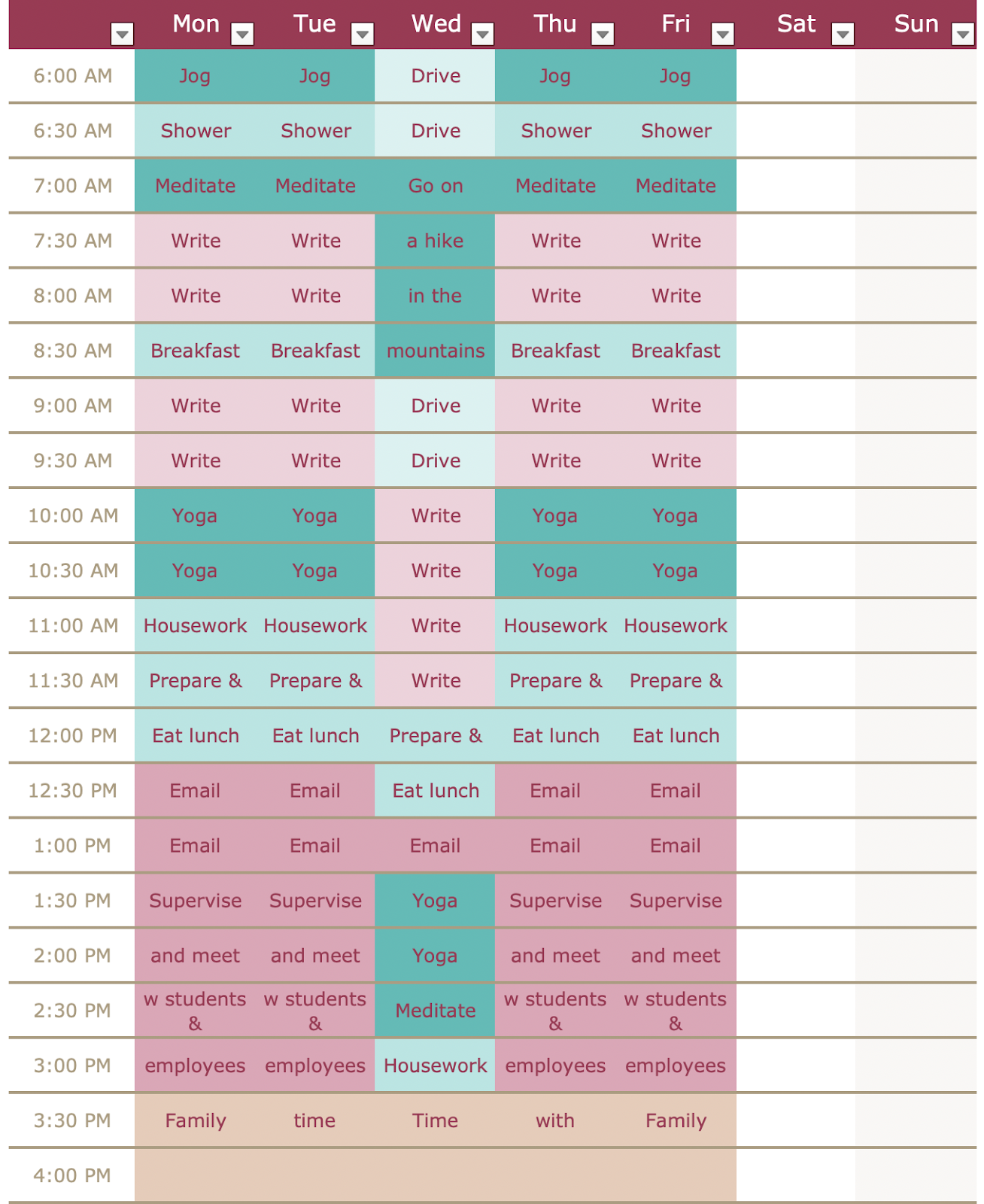
My Summer 2020 weekly template

Unfortunately, I won’t be able to just write for two hours and call it a day because I have lots of other work to do that is not deep work. Thus, I plan to set aside another two to three hours each weekday to manage the dozen or so employees I have working for me, to respond to emails, and to plan out and troubleshoot my ongoing research.

I also know that exercise and self-care will be very important so I have set aside time in my schedule for those activities.

I show you my summer plan here and will walk you through the logic behind my decisions. I wake up very early. I am an early riser, so this is not difficult for me. Also, as I mentioned above, it gets very hot here in Merced, California. However, the early morning hours are cooler and this is the time I would be able to get in a jog. Thus, I plan to jog for 30 minutes four days a week, first thing in the morning.


I also will meditate just before writing as I find that meditating greatly improves my focus and helps me get into the mindset of doing deep work.

Sitting for two hours is not the best thing for my back, so I will do yoga after meditating to stretch out those kinks. Then, I will take a break to have lunch and do some housework. Then, I will spend 2 to 3 hours taking care of email and meeting with my students and employees before dedicating the rest of the day to hang out with my partner and our three teenage daughters.

And, one day a week I will break up this routine and go on a long morning hike. I chose the morning time because this is the only time it will be cool enough for a long hike.

You will notice that I also set aside time for email and housework. The logic behind doing that is that, knowing that I have those activities on my calendar will make it easier for me to not get lost in email when I should be writing or decide that I really need to dust the ceiling fans during times I have set aside for writing.

How about you? Have you come up with a weekly template for your summer? Will you be able to set up an hour or two of distraction-free time for yourself?

Friday, April 3, 2020

How to make effective teaching videos for online instruction

When preparing an online class, videos may be the first thing to come to mind. And, videos can be a great idea. However, you certainly do not want to transform your 50-minute lecture into a 50-minute video.

Instead, think carefully about your learning goals for each class session. And, think about which portions of your lecture class are best suited for video format.

You can teach your learning goals that don’t require videos through lecture notes, assigned readings, discussion boards, podcasts, and online activities. (You can check out my LMS site for some examples.)

Once you’ve settled on a learning goal you think is well-suited for a short video, the first step is to do an online search to see if someone else has already made an excellent short video on the topic. There’s absolutely no need to reinvent the wheel. If you want to introduce a concept and there is a highly produced, scientifically accurate video freely available online, by all means, use that one.

(For example, I have created 18 videos for teaching race and racism, and you may find some of these useful instead of creating your own video that explains the difference between race and ethnicity or what racial formation theory is.)

If, on the other hand, there is nothing available that conveys exactly what you’d like to teach, it’s time to make your own short video.

How to make own videos for teaching

Making videos for teaching can be fun, although making high-quality videos takes a lot of time. I took over a year to make those 18 videos, and I had a lot of help. Here are a few simple steps to follow to make your videos.

Step 1: Write a script.
Your script should be between 100 and 500 words. It takes about one minute to read 100 words, so that will keep your videos at an ideal length of 1 to 5 minutes.

Step 2: Decide on the media for each sentence.
Look at each sentence in your script and decide on the best way to convey that sentence. There are at least four possibilities: 1) live-action; 2) still images; 3) slides with words; and 4) pre-recorded videos.

Our brains use two primary channels to take in information – audio and visual. We can use both channels simultaneously but can only take in input on one type of channel at a time. Both listening to and reading words are on the audio channel. So, we can listen to audio and look at an image. But, we can’t listen to audio and read words at the same time. Thus, if you show words on the screen, use the same ones you are speaking, and keep the words minimal.

Step 3: Create a story board that assigns media for each sentence in your video.

I use PowerPoint for my story boards, but you should use whatever technology is easiest for you. Some people like to use Excel sheets for story boards, for example.

Photo of Woman Holding Brown Book With Her Child
Photo by Andrea Piacquadio from Pexels
https://www.pexels.com/photo/photo-of-woman-holding-brown-book-with-her-child-3818561/

Step 4: Start with still images.
There are tons of free images available on sites like pexels, unsplash, and flickr. You can also find historical images in wikicommons. Try to find images that add value to what you are saying. If you are talking about emotional bonds, for example, you can show a photo of a mother and child. The image reinforces the message. Look at each sentence and decide if it can be conveyed using an image.

Step 5: Add in one or two pre-recorded videos.
Pexels and other sites also have free videos available that you can record your voice over. The use of moving images instead of still images can keep the viewer entertained for longer periods of time. There may also be concepts that are better captured through movement such as the movement of boats across water to discuss migration via sea routes.

Step 6: Add in slides with words, phrases, or figures that are critical.
Your slides with just words on them should be minimal. But, if there is a definition, concept, sentence, or figure students need to see, include a slide with that concept.

Example of a slide that includes a definition and an image.

Step 7: Include some live-action
Live-action involves you speaking. When students see your face, it creates a human connection. So, having some live-action is useful. It can be a good idea to include some live-action at the beginning or in those places where you can’t find an image that works well.

As should be clear, making good videos takes a lot of thought and time. So, only make videos for your classes if you have determined you really need them. Otherwise, use alternative methods of conveying information.


Monday, January 6, 2020

How to Have a Productive Day Working from Home

It seems as if it should be straightforward – if you have the whole day to work at home, you should be super productive. Just work all day, long, right?

If you are able to consistently have days where you sit in front of your computer and write for hours on end, then kudos to you. I, on the other hand, find that if I am not mindful about how I spend my time, a day that is free of appointments can end up being a frustrating, unproductive day.

I love my home office!

My very best writing days are the ones I have at my annual writing retreat, where I am in a beautiful location, surrounded by amazing women writers. I try and replicate that experience about once a month by meeting up with friends at a mountain café and then going on a hike with them afterward. Alas, I can’t do a mini-retreat every day or even every week.

I can, however, work my schedule such that I have at least one day where I work from home. And, how I cherish those days!

Here is my recipe for a productive day of work from home:


Wake up: 5:45am (I know … I am an early riser)

5:45-6:00am: Prepare my almond milk latte and sit on my couch and savor it.

6:00am-7:00am: WRITE!

7:00-7:20am: Take my daughter to school (We live in a small town so I can do a round trip in 20 minutes)

7:20-8:30: Go for a run and have breakfast.

8:30-9:30am: WRITE!

9:30-10:00am: Shower and get ready for the day (I always need a little break after a long writing session)

10:00-11:00am: Reading and/or data analysis

11:00am-11:30: Lunch prep (I do love putting things in my Instant pot and then getting back to work).

11:30-12:30pm: Reading and/or data analysis.

12:30-1:00pm: Lunch

1:00pm-2:00pm: Email (It is important to avoid email for most of the day to stay focused but I can't ignore it all day, so after lunch is a good time to check it.)

2:00pm-3:00pm: Review papers. Take care of administrative business.

3:00pm-3:30pm: Youtube Yoga session

3:30-4:30: Meet colleague for tea or have phone call.

4:30-5:00pm: Final email check of the day

5:00pm: Shut down work for the day


If you are counting (and I know some of you are), that’s 2 hours of writing; two hours of reading and/or data analysis; 90 minutes of email; one hour of meetings; and one hour of administrivia.

For me, that would be a super-productive day at home. What is most important to me about this schedule is that I get all of my focused work done in the morning. In my experience, the single most important thing I need to make this happen is to avoid email and social media before finishing all of my focused time. The second most important thing is to have a clear cutoff time for email – where I stop checking email for the day.

Having this schedule is also helpful because, when I am writing, I might start thinking: “I really should put a load in the laundry.” If I have some light housework on my schedule, I can just tell myself that I will do it at the scheduled time. Likewise, if I remember an email I have been meaning to send, I can make a note and then send it when my email time comes around.

I also will schedule phone calls in the afternoon of my stay-at-home days because I often can take those calls while going on a nice walk around my neighborhood. Having this schedule in mind makes it easier for me to time those phone calls well.

How about you? What does an ideal work-from-home day look like for you?

PS: We have had a couple of cancellations for our retreat in Belize this June. Apply here today and we may be able to get you a spot!


Thursday, January 2, 2020

Don’t Check Your Email in the Morning


Woman in White T-shirt Holding Smartphone in Front of Laptop

You likely have heard this advice before. You may have even followed it for some time. You may have even read the book: Never Check Email in the Morning. But, if you’re anything like me, you tried avoiding email in the morning, and it worked for a while before you slipped back into your old habits.

We tell ourselves all kinds of stories for why we have to check email in the morning. Here are a few things I tell myself:

  • It’s efficient to check and delete emails from my phone while drinking my morning coffee.
  • It’s important to know what’s coming for the day.
  • There may be something urgent I need to respond to.
  • I can quickly scan my emails and then move on to other tasks.


Despite what I may tell myself, I am not that important. Nothing will happen if I don’t check my email all morning. And, although it may seem efficient to scan my email in the morning, it is not.

I recently read this great book by Cal Newport called Deep Work. In that book, he describes research which reveals it is harder to focus after checking email or social media. He explains that any activity you do affects your level of focus in the next activity you engage in. Thus, even if you take five minutes to scan your email or scroll through Twitter, that experience will leave a residue. The “attention residue” from email or social media is detrimental to your ability to focus on the next task. Email and social media are particularly detrimental to activities that require a high level of focus such as writing.


You will be able to achieve a higher level of focus and clarity in your writing if you get your writing done before checking your email and social media accounts.

I am Department Chair this year and I have to respond to lots of emails in that and other administrative capacities. During the Fall semester, I was able to handle those responsibilities while also getting my writing done in September and October. In November, however, I added three out-of-town trips to my already packed schedule and my writing fell by the wayside. Looking back, one of the main reasons I got so little writing done in November is that I began my days responding to emails. Once I opened my emails, it was difficult to achieve the focus I needed to make progress on my writing.

When I couldn’t focus on my writing, I turned to social media, which was a further distraction from my writing.

Thus, in the coming Spring semester, I am going to avoid email and all social media until I complete my writing tasks for the day. Then, I will limit both activities to specific times of the day.

My plan is to wake up at 6am, write for one hour, take my daughter to school, go for a run, have breakfast, and then sit down for my second writing session. Once my second session is over, I will check my emails. I then will close my email and check it again at the end of the day. At 5pm, I will log out of my email and close the program until the next day. In Deep Work, Cal Newport also recommends having an official end to the workday to allow the mind time to reset and refocus.

I also set up my phone so that I am limited to a total of 30 minutes per day on social media. I will only engage with social media once I have finished my writing and will avoid social media after dinner. This will allow me more time to spend focusing on my family as well as reading great books.

It should not be difficult for me to keep this routine during the month of January, as my semester does not officially start until January 14th and classes don’t begin until January 21st. Thus, no one expects a quick response from me during this time. My hope is that I will be emboldened and inspired by my writing productivity during the month of January and that I will thus keep this up for the rest of the semester.

How about you? What will it take for you to get your email and social media habits under control?

Thursday, July 11, 2019

Seven Strategies to Help You Become a More Creative and Productive Writer

Would you like to become more creative, more focused, more relaxed, and more productive? Did you know research shows there are specific habits you can develop that will enhance your ability to be all of these things?

Imagine writing in this environment!

There are many myths prevalent in academia that make it difficult for many of us to imagine we can be creative, focused, relaxed, and productive. These myths include: “the only way to be successful is to work all the time;” “some people are gifted writers;” “I can only write when I feel inspired;” and “a balanced life is impossible when you are on the tenure track.” These myths are counterproductive and prevent many academics from reaching their full potential.

Instead of believing these myths, I know that anyone can become a great writer by practicing their writing; that you can be successful and have a life too; and that there are specific strategies you can learn that will help you tap into your creativity.

Developing new ideas, which is at the core of academia, requires being creative. Your ability to tap into your creative potential is severely limited when you are frazzled, stressed, and overworked. Thus, although it might seem contradictory, being productive requires setting limits on how much you work.

I am sure you can think of a few writers you admire for their craft. I am also sure that those writers did not just wake up one day with the ability to write. Instead, they developed that skill over many years. The good news is that you can do that too. You can develop the ability to write clearly and convincingly, by practicing and honing your writing skills.

There are many strategies you can learn that will help you to become less stressed, more creative, and more productive. Seven of my favorite strategies include:


  • Daily writing


  • Unplugging


  • Spending time in nature


  • Meditation and mindfulness


  • Getting 7 to 9 hours of sleep


  • Getting regular exercise


  • Connecting to others via conversations about your work


  • You can find ways to incorporate these strategies into your summer writing routine. For example, have you considered writing every morning before connecting to the Internet? Have you tried meditating? Are you using the summer months to catch up on your sleep? Are you enjoying the beach or the mountains this summer? Have you considered taking a walk without your phone in the evenings?

    If you would like some help thinking about how to do all of these things, I incorporate all of these strategies into the Creative Connections writing retreat I co-facilitate every year. If you are interested, we have a few spots left for the June 2020 retreat. Participants find that this retreat is the perfect way to refresh and start their summer.

    The Creative Connections writing retreat for women academics is based on the idea that there are four elements that lead to enhanced creativity: 1) focused writing time; 2) spending time unplugged and in nature; 3) connections via conversations about our work; and 4) meditation and mindfulness activities that enhance focus and allow us to tap into our creative potential.

    This retreat will use a combination of these proven techniques to create a space that not only provides for productivity during this week, but that also teaches participants valuable skills they can use for the remainder of their careers. Producing cutting-edge scholarship requires imaginative and creative abilities and this retreat is designed to maximize creativity and productivity.

    The retreat is already 50% full. If you are interested, apply today to secure your spot.

    Whether or not you are able to join I wish you a creative, productive, and relaxed rest of your summer and look forward to hearing in the comments the ways you use to tap into your creativity.

    Thursday, October 25, 2018

    Why Daily Writing Leads to Productivity

    I began developing my daily writing habit in December 2006 – over ten years ago! Since then, I have written almost every weekday, except for vacations, of course. And, I have written a ton. I also have published a lot.

    In 2006, when I began to write daily, I had two published articles and a dissertation. Today, I have published five sole-authored books, over 50 articles and book chapters, and dozens of blog posts, online essays, and OpEds.

    A few years ago, I wrote a post about how to write every day.

    This post is about why daily writing works.


    I have writing on my calendar every morning. I write for two hours a day most days, and I get in a minimum of 30 minutes of writing on days when my schedule is packed with teaching and/or meetings. I thus write for a minimum of 30 minutes and a maximum of two hours every weekday.

    At the beginning of the week, I decide what writing tasks I will work on, and which days I will focus on which tasks. Sometimes, I have no pressing deadlines. This means I have to think ahead to figure out which writing tasks I should focus on.

    For example, I have an article due November 15. But, my co-author is working on it. I need to wait to hear back from her before I can work on it again. I also have been working on a grant proposal due in January. But, I don’t want to work on it now because I sent a draft to two readers. I am waiting to hear back from them before I get back to revising it. This means I don’t have anything to work on right now that has a deadline in the next couple of months.

    I thus am writing today only because it is a habit – not because I have an upcoming deadline.

    On Sunday evening, I pulled out my task list for the year to see what I can work on.

    I have three pieces due at the end of February 2019. For two of them, I have to wait for co-authors to do their part before I can move forward. But, there is one of them that I can work on. I thus am likely to finish that piece way ahead of schedule. And, that is great because I have two other pieces also due in late February.

    I think this is one of the main reasons daily writing leads to high productivity. If you set aside time to write, you will write regardless of whether or not you have an impending deadline. And, if you wait until you have a deadline to write, you might find that your deadlines are stacked together, making it difficult for you to meet them.

    My preference is to write daily, but the most important thing is that writing becomes a habit. If you set aside two days a week to write and write on those days no matter what, I suspect you would find the same thing – that you write because it’s on your schedule, not because you have a deadline.

    What about you? Have you developed a writing habit? Have you ever found yourself writing even though you don’t have an impending deadline?

    Thursday, May 31, 2018

    How to Restart Your Writing Practice: A Few Ground Rules

    Are you looking for a reset after a long year of teaching? Are you struggling to get back into your writing for the summer?

    Many academics are mentally, physically, and emotionally exhausted at the end of the academic year. So, the first step is to intentionally take some days off. At a minimum, take the weekend off. And, make sure you have some summer vacation planned, as you will need a real break. I plan a two-week vacation with absolutely no work every year. This year, after my writing retreat, I will spend that vacation in Peru! I hope you are also planning a vacation for yourself this summer.


    Once you are ready to get back to work, one strategy that might work for you is to set some ground rules for yourself to get back into your writing practice. I set ground rules for myself and adjust them according to the season. I find they are helpful to keep me on track with my writing.

    Here are some examples of ground rules for getting your writing done:


    1. No social media before noon on writing days.
    2. Don’t check email until writing is complete.
    3. Complete two hours of writing before doing any other work or household tasks.
    4. Take the weekend completely off.
    5. Get some exercise 3 days a week.
    6. Spend at least one afternoon a week enjoying nature.
    7. Read fiction at least 30 minutes a day.

    You may notice that only one of these sample ground rules is actually about writing. The first two are about what not to do before you write and the last four are about self-care. That is because, in order to ensure you write every day, you also need to take steps to avoid distraction as well as take time to refresh. And, summer is a great time to get back into fiction reading. (I am currently reading The Ministry of Utmost Happiness - what's on your list?)

    What do you think would be good ground rules for you? What do you need to do to keep up your writing practice this summer?

    If you want to be a super-nerd about this, you can do what I do, which is to create an Excel spreadsheet with your ground rules and give yourself a gold star for each week that you meet all of them.

    Also, keep in mind that it is perfectly fine - even recommended - to change your pace of work during the summer. I talk a bit more about "summer hours" in this post.

    I wish you a productive and relaxing summer – at least for those of you in parts of the world where it is summertime!

    Sunday, April 8, 2018

    How Academic Parents Can Find Time to Exercise

    A question that often comes up when I do campus workshops on work/life balance is how and when busy academic parents can find time to exercise. As we get older, it becomes increasingly important for us to exercise in order to stay healthy and keep our stress levels in check. I find time to exercise because I know how important exercising is for my mind and body.

    Like many aspects of work/life balance, how and when I exercise is something that has shifted over the course of my career.

    Here are a few tips on ways to make time to exercise as an academic parent.

    Jump

    Find a gym that has daycare
    When my children were of pre-school age, I took advantage of the childcare offered at the YMCA in order to be able to work out. One strategy that worked for our family is my husband and I would alternate between going to the gym and cooking dinner. For example, on Mondays and Wednesdays, I would pick the kids up from daycare and drive them to the gym. My husband would stay home and cook. We’d get home around 7pm and eat dinner together. He would go to the gym on Tuesdays and Thursdays with the kids and I would cook.

    Some parents may not like the idea of having the kids in daycare all day and then taking them to the daycare at the gym. However, we found this system allowed us to spend quality time with the children during and after dinner. And, that was much preferable to us being stressed out and trying to prepare dinner with the kids running all over the house.

    Exercise with your kids
    Another way to get exercise in is to exercise with your kids. When my twins were infants, I would bundle them up in the jogging stroller and take them out for a jog or a walk. As they got older, I could walk or jog around the track while they biked. Eventually, I could walk or jog with them alongside me. Taking long walks with my tween daughter was extremely helpful for both of us at one point.

    Exercise while your kids are doing something else
    Once my children became school-aged, I often had to take them to various afterschool activities. For example, I would drop my youngest daughter off at gymnastics for her 90-minute practice. Instead of waiting at the gymnasium with her, I would drop her off and use that time to exercise. Sometimes I would go to the gym and other times I would go for a walk or jog in the neighborhood near her gymnasium. When she played soccer, I would walk or jog around a nearby track during her soccer practice.

    Exercise while your kids get themselves ready for school
    As my children got older and became capable of getting themselves ready for school, I realized that the early morning was a perfect time for exercise. My teen-aged kids wake up and begin to make noise around 7am and leave the house around 8am. I am always awakened by their noises. Thus, I get myself out of bed, put on my jogging clothes, and go out for a 30-minute jog in the morning while my kids shower and get dressed. I then make it back in time to have breakfast with them. The bonus is that I don’t have to hear the kids arguing about whose turn it is to take a shower!

    Just do it
    I have been meaning to do yoga on a more regular basis for years. However, the class schedules never seem to align perfectly with my schedule. My gym has an 8am yoga class that I really enjoy on Tuesdays. That doesn’t work perfectly with my schedule because the class is from 8am to 9am, and it means I don’t get home until 9:15, and I can’t realistically start working until about 9:45. That puts a real dent in my morning productivity. However, I made a decision that I am going to just do it. I am going to go to my once-a-week yoga class even if it means I will have a little less time for writing on Tuesdays. I have been doing that for about a month, and, guess what, everything is fine!

    Have walking meetings
    One way to get some mild exercise into your day is to have walking meetings. For example, if you need to meet with a student and the weather is nice, you can offer to walk and talk for your meeting. I have also gotten into the habit of arranging my phone meetings at times when I can take the phone call while walking. That way, a 30-minute phone call turns into a 30-minute walk. Of course, there are some meetings that require you to be in front of a laptop. But, there are many that solely require your attention.

    It can be challenging to find time to exercise when you have kids of any age. However, if you are creative with your schedule and willing to prioritize getting in your exercise, you should be able to make it happen.

    What are your tips for finding time to exercise when you have young children?

    Tuesday, February 13, 2018

    Getting the Most out of Academic Travel: The Ideal Work Trip

    I have been traveling a lot for work lately, which is great, but it also means I need to make decisions about which invitations to accept, as well as what to ask of my hosts to make travel more feasible and enjoyable. Jet-setting around the world can be fun, but also exhausting.

    Several years ago, I wrote a blog post about my "ideal day," inspired by Barbara Sher's book, Wishcraft. I think of this exercise often, although my ideal day has shifted a bit since 2011, as I have gained clarity on what I want and need, and what makes me happy.

    During a recent work trip, I realized I could use the "ideal day" exercise to think through what my ideal work trip would look like. What kind of work trip would I look forward to?

    Envisioning what an ideal work trip would look like allows me to try and arrange my visits to reflect that - and to actually enjoy traveling for work.

    Here is what I came up with for my ideal work trip:
    Photo from a recent work trip to Costa Rica!

    Tuesday evening:
    Pack for my trip so that my travel bag is ready to go.

    Wednesday morning:
    6:00am: Wake up at home and write for an hour
    7:00am: Go outside for a jog.
    7:40am: Have breakfast with my family before they leave for the day.
    8:00am: Shower, get ready.
    8:30am: Write for another hour.
    10:00am: Leave the house for my work trip
    … travel to my destination ….
    6:00pm: Have an engaging dinner with hosts
    8:00pm: Back at hotel, relaxing with a novel

    Thursday morning:
    6:00am: Wake up and write for an hour
    7:00am: Go outside for a jog or to hotel gym if weather is not suitable
    7:40am: Have breakfast.
    8:00am: Shower, get ready for the day.
    8:30am: Write for another hour.
    10:00am: Leave the hotel for a day of engagement with hosts and other guests
    … this day can include meals, talks, meetings, and downtime …
    8:00pm: Back at hotel, relaxing

    Friday morning:
    6:00am: Wake up and write for an hour
    7:00am: Breakfast
    7:30am: Shower, get ready.
    8:00am: Write for another hour
    9:00am: Leave the hotel to do something enjoyable - preferably a long nature hike. If I'm in a city, visit a museum or something I can only do in that location.
    12:00pm: travel back home
    ….
    6:00pm: Back home with my family

    My ideal workday at home involves waking up early, exercising, and getting a couple of hours of writing in. My ideal work travel visit also involves having some alone time in the morning when I am writing and not skipping out on my exercise routine. If I can travel and keep my writing routine going, I feel better about my projects. If I can travel and find time to exercise, I feel better all around.

    I enjoy engaging with others. But, I have also realized that one full day of engagement with people is plenty for me. So, I can request that my meetings be limited to one day. I enjoy having meals with people and trying new food, so I also try and arrange my travel such that I can make it in time to have dinner the night before.

    When I travel, I also enjoy doing at least one activity that I can only do in that place. During a recent trip to Oregon, I went on a hike up a butte, for example. And, when I went to Costa Rica, I was able to visit a volcano!

    I travel a lot for work, and often miss my family when I do. It thus works better for me to travel during the week so that I am home on the weekends and can spend time with my partner and three kids.

    Now that I have a sense of my ideal work trip, I can aim to mold my future trips to emulate this as much as possible.

    Of course, I am dependent on airline schedules, conference schedules, and my hosts' needs and location. However, knowing what I want makes it easier for me to make decisions about which invitations to accept, as well as when to schedule my flights.

    For example, I have an upcoming trip to give a public lecture on a Thursday evening. I am unable to leave on Wednesday for that trip so I will have to leave early in the morning on Thursday. I have a three-hour flight, so hopefully will be able to get at least an hour worth of writing done on the plane. I have asked my host to schedule all of my meetings on Thursday so that I have Friday to myself. I will wake up on Friday, write for a couple of hours, and then find a great place to hike and have lunch before getting on a plane back to California.

    Now, I am looking forward to that trip and especially to finding a cool place to hike!

    What about you? How are you handling work travel these days? What does your ideal work trip look like?